
Story of Seasons: Friends of Mineral Town (SoS FoMT) is a remake of the classic Harvest Moon game that originally came out in 2003 for the Game Boy Advance. Since then, it’s become one of the most beloved farming life sims of all time.
Thanks to its popularity, Friends of Mineral Town has drawn in players of all ages and even inspired other hit games like Stardew Valley, My Time at Portia, Farm Together, and Kynseed.
Now, almost 20 years later, Friends of Mineral Town is back with a full remake featuring updated graphics and a modern game engine. Due to changes in the franchise’s licensing, the game is now officially released under the Story of Seasons name instead of Harvest Moon.
In this guide, we’ll be sharing our experience playing SoS FoMT. We’ve tried to make it as complete and helpful as possible, and we’re always open to feedback or suggestions from fellow players to help make it even better over time!
Story
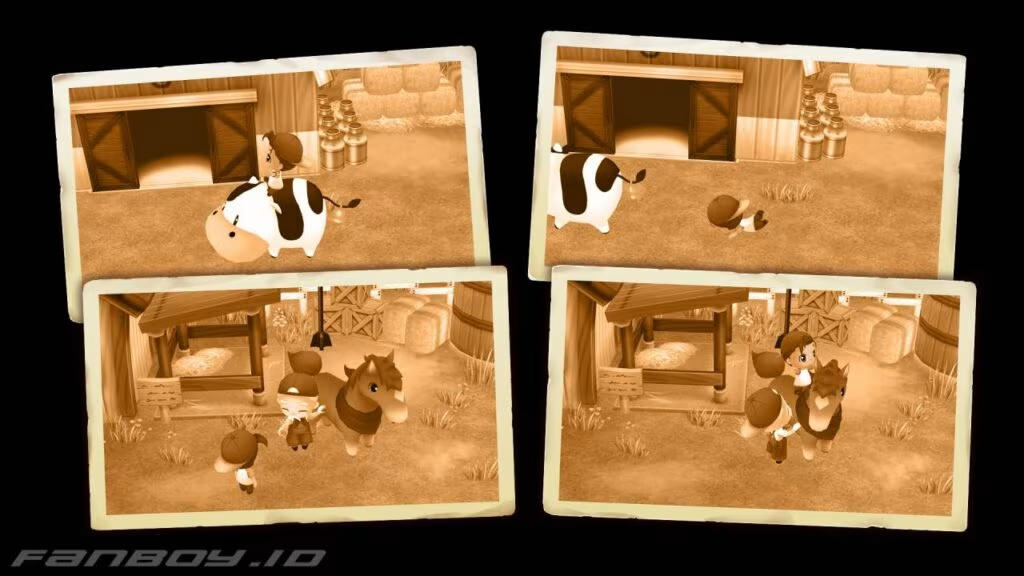
Since this game is a remake of Harvest Moon: Friends of Mineral Town, the core story remains familiar — but it still tugs at the heart.
As a child, you spent a summer on your grandfather’s farm, where you experienced the warmth of rural life and formed a special friendship with another kid. Before leaving, you promised to come back someday.
Years later, life brings you back to Mineral Town. A letter from Mayor Thomas informs you that your grandfather has passed away, and he’s left the farm to you. When you return, the place is in ruins — a shadow of the peaceful haven you once knew.
Now, it’s your turn to breathe new life into the farm, connect with the townspeople, and create new memories in the place where it all began.
Game Features
While the remake stays true to the original GBA version in terms of core gameplay, it comes with a bunch of modern updates and quality-of-life improvements to match other Story of Seasons titles.
For example, when you start the game, you can choose between Simple Mode or Normal Mode, depending on how relaxed or challenging you want your experience to be.
The characters you know and love from the 2000s version are still here, but they’ve all been visually refreshed. Igusa Matsuyama, the series’ lead artist, has given them a brand-new look that blends classic charm with a more modern style.
Here are some of the major updates and new features in the remake:
- Same-sex marriage is now possible, along with two new marriage candidates
- All marriage candidates now have two additional heart events
- Inventory management is easier thanks to stackable items in your backpack
- Mining is more efficient with the addition of pitfall holes and an elevator
- Crops now have a quality rating ranging from 1 to 5 stars
- New crops include Soybeans and Chili Peppers
- Your character can now walk over crops, improving mobility
- Barns now have a bell outside to call all animals out at once
- New animals include Angora Rabbit, Brown Chicken, Alpaca, Strawberry Cow, Fruit Cow, and Coffee Cow
- Horses can now roam freely outside the barn
- There are more pet options, including dogs, cats, capybaras, and penguins
- A mirror inside your house lets you change outfits anytime
- A new garden area has been added between your farm and the town inn
Getting Started
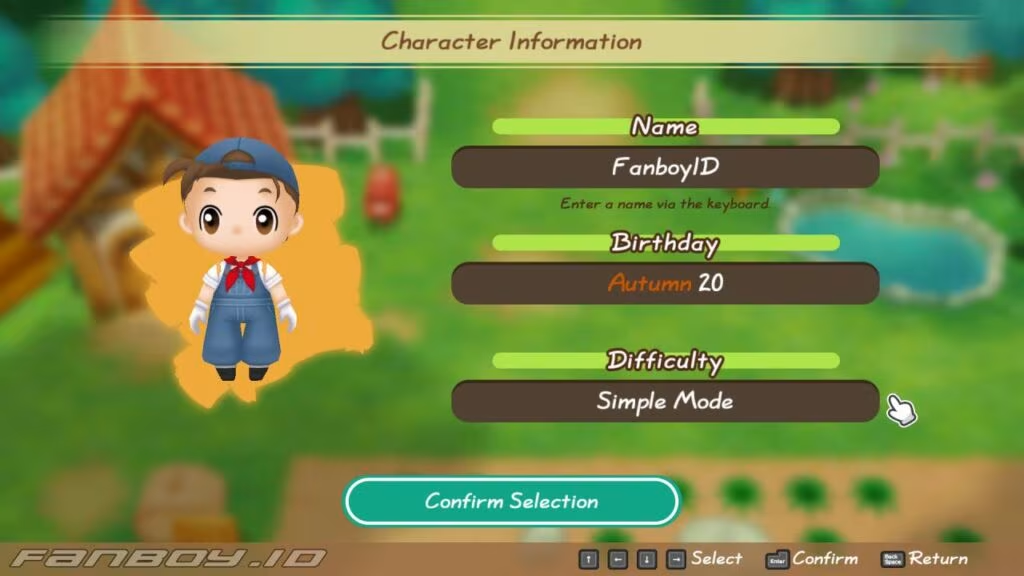
The game supports up to 8 save files, giving you plenty of room for multiple playthroughs. When starting a new game, you’ll need to choose the following:
- Skin color
- Character appearance and gender
- Character name
- Birthday
- Difficulty level
Keep in mind that these choices cannot be changed once confirmed.
Character Selection
When you start the game, you get to choose from four playable characters. Pete and Claire are the OGs from the classic Harvest Moon days, while Yuuto and Naomi are the new kids on the block added in the remake. You can also pick from three different skin tones to customize your look.
Heads up though — once you lock in your character and skin tone, you can’t change them later, so make sure you’re cool with your choice. Don’t worry though, you can switch outfits anytime during the game.
There’s a mirror in your house that lets you change your outfit style — classic or modern — depending on your character’s gender. So if you’re playing as Pete, you can wear Yuuto’s hoodie, but you won’t be able to rock Claire’s overalls.
Choosing a Name
Your character’s name can be up to 8 characters long. This name cannot be changed after the game starts. The same 8-character limit applies when naming livestock and pets.
Birthdays
As in other Harvest Moon and Story of Seasons games, the calendar consists of four seasons (Spring, Summer, Autumn, Winter), each with 30 days. You can choose any date as your character’s birthday.
However, if you choose the same date as a marriage candidate’s birthday, their birthday will be moved to an alternate date. For example, if you pick Summer 3 (Popuri’s birthday), her birthday will shift to Summer 10.
You can share a birthday with other villagers, and even with festival dates — the game only prevents you from having the same birthday as your romantic interest.
On your birthday, you’ll receive letters with birthday wishes in your mailbox from villagers and potential marriage candidates. There are no parties or gift exchanges. As long as you’ve been socializing normally, you’ll receive birthday mail — even if no one directly mentions it in person.
After you’re married, you can celebrate your birthday with your spouse. Enter your home between 7:00 PM and midnight to trigger a special cutscene.
If you choose the correct answer, “It’s my birthday!”, you’ll receive:
- +3000 Love Points (LP) from your spouse
- +20 Friendship Points (FP) from your child (if you have one)
Choosing any other answer will result in:
- -2000 LP from your spouse
- -10 FP from your child
Likewise, you can celebrate your spouse’s birthday in the same way. This is why the game won’t allow you to choose the same birthday as your romantic partner.
Difficulty Modes
There are two difficulty options when starting a new game:
Normal Mode
- No bonuses
- You begin with 500 G
- Must build up your farm entirely from scratch
Simple Mode
This beginner-friendly mode offers a few early-game advantages:
- Start with 2500 G
- 9 Turnips ready to harvest, and 9 Turnips already sprouted
- +20% profit from shipped items
- +20% friendship points from gifting (note: Love Points are not affected)
Game Menu
You can access the game menu by pressing the X button (console) or P key (PC). There are six tabs available that provide various in-game information. You can navigate between tabs by moving left or right.
Settings
This menu allows you to adjust several game features, including:
- Max Volume
- Background Music (BGM) volume
- Sound Effects (SFX) volume
You can also toggle the Heart Icons on or off. These icons appear above marriage candidates’ heads when you talk to them.
Another option is to turn off character portraits during conversations. The character’s name will still appear in the dialogue box.
You can enable or disable the Guide Icon, which is a pop-up message that appears when standing near something interactive.
If you’re using a controller, it will vibrate when using tools or fishing. You can disable this by setting HD Rumble to Off.
The PC version of the game offers additional settings such as:
- Display Mode
- Resolution
- Anisotropic Filter
- Anti-Aliasing
- Vsync
- Shadow Type
- Depth of Field
These can also be adjusted in the configuration launcher, where you can also select the game language (English, Japanese, Spanish, German, Chinese, or Korean).
The Button Preset section allows you to choose control presets on the Nintendo Switch. On PC, you can customize the keyboard or controller settings.
Farm Info

This tab provides a summary of your in-game progress, including:
- Farm name and current in-game year
- Player name
- Farm Degree Rank
- Birthday
- Number of Power Berries collected
- Number of the 7 Rings unlocked
It also displays your family member(s) and relationship progress (hearts and music notes) in the Relationships menu.
On the right-hand side, it shows:
- Number of pets owned
- Number of livestock
- Amount of animal feed
- Number of Chicken/Rabbit Feed in storage
- Field Level
- Total Lumber and Stone (in house and backpack)
Items
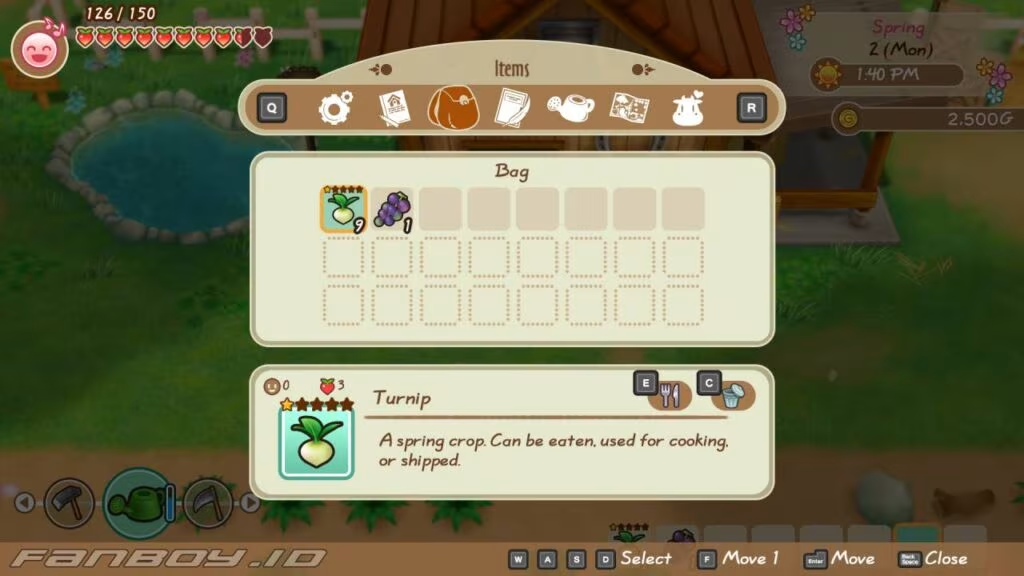
This menu shows all items in your backpack. You can scroll through them and read each item’s description at the bottom of the screen.
You can:
- Choose how many items to eat or discard at once
- Eat items to restore stamina and reduce fatigue
- Discard items
Journal
The Journal is where you save and load your game. It’s the default tab that opens when you press X (console) or click left (PC).
- You can save up to eight files
- Loading a saved game is also done here
On the Nintendo Switch, you cannot delete individual save files manually.
On PC, save files are located in:
%userprofile%\AppData\Roaming\SOSFoMT
Each file is numbered:
DPlaydata_0= Autosave slotDPlaydata_1= Save Slot 1- and so on.
Deleting a DPlaydata file will cause Steam to re-download it when you open the game again.
Tools
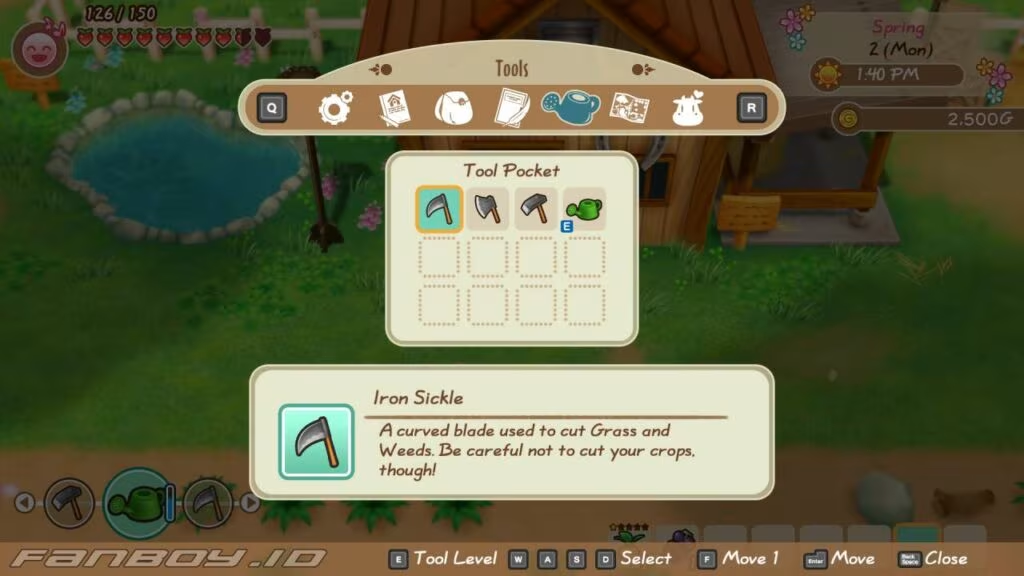
This tab is similar to the Item menu but specifically shows your tools. You can:
- View each tool’s experience level
- See the current upgrade level
- Track progress toward the next upgrade (in %)
- Check if the tool is ready to be upgraded at the Forge
Minimum experience required for upgrades:
| Upgrade | Required EXP |
|---|---|
| Copper | 10% |
| Silver | 28% |
| Gold | 55% |
| Mithril | 100% |
You can skip upgrade levels if your tool meets the required EXP. For example, a Copper tool with 65% EXP can be upgraded straight to Gold.
Relationships
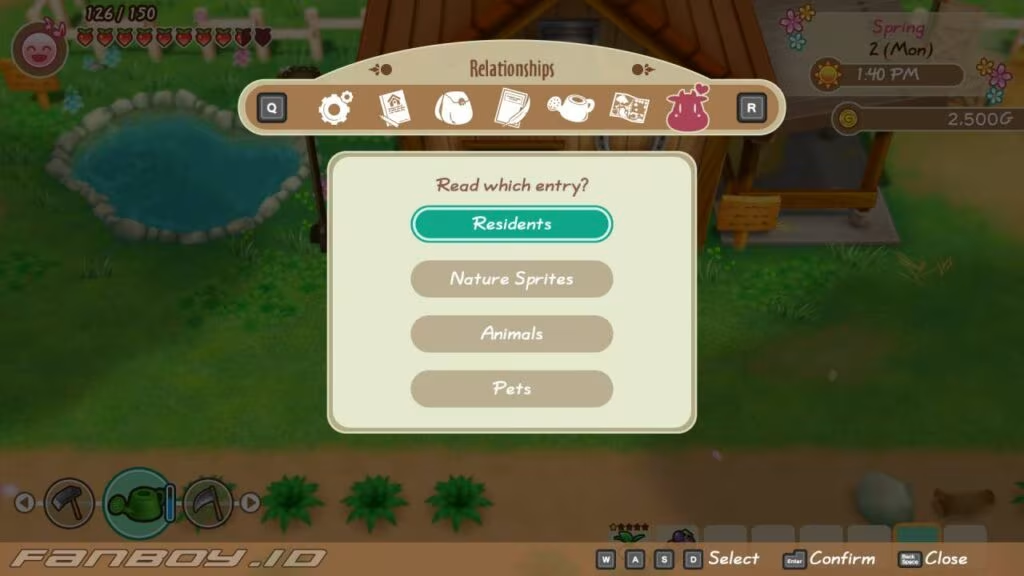
This menu shows your friendship and affection status with:
- Villagers
- Nature Sprites
- Animals
- Pets
Residents
You can sort villagers by:
- Friendship level (music notes)
- Romance level (hearts)
- Default list order
An icon will light up if you’ve spoken to or given a gift to someone that day.
Nature Sprites
Shows each sprite’s:
- Friendship level
- Helper skill level (colored bar)
- Days remaining on their assigned task
Higher skill means better work performance.
Animals
Lists livestock first, followed by poultry and rabbits. You can see:
- Number of hearts per animal
- Whether you’ve spoken to or fed them that day
Pets
his section shows your horse and other pets, along with:
- Their friendship hearts
- Whether you’ve talked to or given them a Pet Treat today
The horse has an extra icon to show if you’ve brushed it.
Below each pet’s heart level is their skill bar:
- The horse’s skill is its stamina bar, which determines how long it can dash during a race
- Other pets’ skill bars show how far they can run when playing Frisbee at Mineral Beach
Related Guides
Farm Degree & 7 Rings
The Farm Degree Rank is an achievement system that reflects your overall progress in the game. In addition, there are 7 special rings that can be obtained by fulfilling specific conditions.
→ [Read more: Farm Degree & 7 Rings]
Stamina & Fatigue
Stamina and Fatigue are health systems that affect your character’s ability to perform tasks. The more stamina you have, the more actions you can take. Fatigue represents exhaustion; ideally, you should keep your character well-rested to avoid passing out.
→ [Read more: Stamina & Fatigue]
Power Berry & Blue Berry
Power Berries are items that increase your total stamina. In addition, the Blue Berry plays a role in managing fatigue (FAT). In Story of Seasons: Friends of Mineral Town, there are 10 Power Berries and 1 Blue Berry, each with its own unique way to obtain it.
→ [Read more: Power Berry]
Love Points & Friendship Points
Friendship Points (FP) and Love Points (LP) are used to measure your relationship with villagers. FP tracks general friendship with villagers, sprites, and animals, while LP is used only with marriage candidates to track romantic progress.
→ [Read more: LP/FP]
Locations & Shops
The game features various locations to explore, including villager homes and 11 shops scattered throughout Mineral Town. Everything you need for farming and ranching can be found here.
→ [Read more: Locations & Shops]
Villagers
There are a total of 48 characters in Story of Seasons: Friends of Mineral Town. Among them are 6 eligible bachelors and 6 eligible bachelorettes. There are also 7 Nature Sprites and around 25 other town residents.
→ [Read more: Character]
Tools
At the beginning of the game, your farmland is overgrown and messy. You’ll need tools like the sickle, hammer, and axe to clean it up. To cultivate the land, you’ll need a hoe.
→ [Read more: Tools]
Farmland
This land was once well-maintained when you were a child. After your grandfather passed away, it fell into neglect. Now it’s up to you to restore the farm to its former glory.
→ [Read more: Farmland]
Crops
There are many types of crops you can grow, each suited to specific seasons. Harvested crops sell for varying prices depending on their type and star rating.
→ [Read more: Crops]
Livestock
You can raise five types of livestock: cows, sheep, alpacas, chickens, and angora rabbits. Each animal produces different products.
→ [Read more: Livestock]
Pets
Pets are different from livestock. While livestock provide products, pets assist you with certain tasks. For example, early in the game, you’ll receive a pony. Once it grows into a horse, you can ride it to travel faster.
→ [Read more: Pet]
Marriage
You can marry one of several eligible characters. The game features both normal and special candidates. Normal candidates include 6 bachelors and 6 bachelorettes, while special candidates include the Harvest Goddess, Huang, Bon Vivant, and Kappa.
→ [Read more: Marriage]
Recipes
There are over 100 recipes you can cook using ingredients from your livestock, crops, foraged items, and ingredients purchased at the General Store.
→ [Read more: Recipes]
Fishing
Fishing is a fun activity that you can enjoy during your free time. To start fishing, you need a fishing rod, which you can get from Zack.
→ [Read more: Fishing]
Item Selling
Most of the items you collect in the game can be sold for extra income. Items from mining, fishing, livestock, and farming all have their own individual sell values.
→ [Read more: Item Selling]
Goddess Gifts
Every time you offer a gift to the Harvest Goddess, it is tracked. For example, giving her 10 gifts over 10 days will earn you a Power Berry. Giving her 150 gifts in total will unlock a private Villa on Mineral Beach.
→ [Read more: Goddess Gifts]
Jewels & Treasures
During gameplay, you may come across Goddess Jewels, Kappa Jewels, and Truth Jewels. These cannot be sold or gifted to villagers but serve other useful purposes in the game.
→ [Read more: Jewels & Treasures]
Wild Item
Each season brings different wild items that can be found across Mineral Town—in nature, near villagers’ homes, and in specific hidden spots.
→ [Read more: Wild Item]
Random Events
There are many random events in the game. These are triggered by specific conditions such as time, weather, and location. Most events include cutscenes with questions that you must answer.
→ [Read more: Random Events]
Calendar
The calendar doesn’t just tell you the current day, season, and year—it also keeps track of upcoming festivals, birthdays, and other important events.
→ [Read more: Calendar]
Festivals
You can participate in various seasonal festivals throughout the year, including cooking contests, horse races, and romantic events.
Villager Birthdays
Take advantage of birthdays to increase your FP/LP by giving gifts that the villagers love. You can also wrap gifts at the General Store for 100 G each, which increases the effect by 25%.
→ [Read more: Birthdays]